

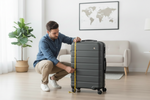
What Size Suitcase Do I Need? A Complete Luggage Size Guide
, by Tariq Rehman, 11 min reading time
, by Tariq Rehman, 11 min reading time
Choosing the right suitcase size can make travel easier, more organized, and less stressful. This complete luggage size guide explains cabin, medium, and large suitcase sizes, what each is best for, and how to choose the right luggage for your trip.
Choosing the right suitcase size can make a major difference to your travel experience. A suitcase that is too small can leave you struggling to fit everything you need, while an oversized suitcase can become difficult to carry and may result in unnecessary baggage fees.
With so many luggage sizes available, it is natural to wonder: What size suitcase do I need?
The answer depends on several factors, including the length of your trip, destination, travel season, packing habits, airline requirements, and whether you plan to check your luggage or take it into the cabin.
From compact carry-on luggage for short trips to large suitcases designed for extended holidays, every size has a purpose.
This guide explains the most common suitcase sizes and how to choose the best option for your next journey.

Suitcases are generally categorized by their external dimensions and capacity.
Although exact measurements can vary between brands, luggage is commonly divided into three broad categories:
Some brands also offer extra-large luggage, while expandable suitcases can provide additional packing capacity when needed.
When shopping for luggage, it is important to look beyond the label. A suitcase described as "large" by one manufacturer may have different dimensions from another.
Always check the actual measurements and capacity before buying.
Small suitcases are designed primarily for short trips and cabin travel.
They are often around 18 to 22 inches in height, although dimensions vary considerably between brands and airlines.
Cabin luggage can be useful for:
The biggest advantage is convenience.
You can potentially keep your luggage with you during the flight rather than waiting at baggage claim after landing.
However, cabin luggage has limited capacity, so packing efficiently is essential.

A well-organized cabin suitcase can hold more than many travelers expect.
Depending on the suitcase design and your packing style, you may be able to fit:
For a weekend trip, a compact suitcase may be more than enough.
For longer journeys, however, you may need to check a larger suitcase.
Medium suitcases are generally a good middle ground between compact cabin luggage and large checked baggage.
They are often around 23 to 26 inches in height, although exact dimensions differ between manufacturers.
Medium luggage is particularly suitable for:
For many travelers, medium luggage offers an excellent balance between capacity and portability.
It provides more space than a carry-on without becoming as bulky as a large suitcase.
Large suitcases are generally around 27 to 30 inches tall.
They are designed for travelers who need substantial packing capacity.
Large luggage can be useful for:
However, larger luggage comes with trade-offs.
The suitcase itself may be heavier, harder to maneuver, and more difficult to store.
A larger suitcase also makes it easier to overpack.

Some manufacturers offer suitcases larger than the typical 28- to 30-inch range.
Extra-large luggage can be useful in specific circumstances, but it is not always the best choice.
The larger the suitcase becomes, the easier it is to exceed airline weight limits.
It can also be physically challenging to maneuver a very large suitcase through airports, train stations, hotel corridors, and city streets.
Unless you genuinely need the additional capacity, a large or medium suitcase may be more practical.
For a weekend getaway, a small suitcase or cabin bag is usually a practical choice.
A compact suitcase can provide enough space for a few outfits, toiletries, electronics, and essential accessories without requiring checked baggage.
If you pack lightly, you may even be able to use a smaller personal item alongside your cabin luggage, depending on the airline's rules.
The key is to avoid taking a larger suitcase simply because you have extra space.
More space often encourages unnecessary packing.
For a trip lasting approximately one week, a medium suitcase can be a practical option, particularly if you need multiple outfits, footwear, and toiletries.
However, a disciplined packer may still manage with cabin luggage.
Your choice should depend on the type of trip.
A one-week summer vacation generally requires less luggage than a one-week winter trip because warm-weather clothing tends to be lighter and less bulky.
Activities also matter.
A business trip may require formal clothing and shoes, while a beach holiday may require swimwear and casual clothing instead.

For a two-week trip, many travelers will find a large suitcase more convenient.
This is particularly true if you're traveling during colder weather or need different types of clothing.
However, there is no rule saying a two-week trip automatically requires the largest suitcase available.
If you plan to do laundry during your trip, you can significantly reduce the amount of clothing you need.
A medium suitcase may therefore work for travelers who pack efficiently.
International travel doesn't automatically mean you need a large suitcase.
The best size depends on your itinerary and how long you will be away.
For a short international trip, cabin luggage can be ideal.
For a longer journey, medium or large checked luggage may be more practical.
Before flying internationally, always check the baggage allowance provided by your airline. Size and weight restrictions can vary depending on the airline, route, ticket type, and cabin class.
Never assume that a suitcase is acceptable simply because it is marketed as "international luggage."
Winter travel often requires more luggage space.
Sweaters, coats, boots, scarves, and other cold-weather clothing take up considerably more room than summer clothing.
If you're traveling somewhere cold for an extended period, a medium or large suitcase may be more appropriate.
One useful strategy is to wear your heaviest clothing during the journey rather than packing it.
For example, wearing your coat and heavier shoes can free up valuable suitcase space.

Business travelers often prioritize convenience and organization.
For short business trips, cabin luggage can be ideal.
A compact suitcase can provide enough space for shirts, trousers, a blazer, toiletries, and electronics while allowing you to move quickly through the airport.
For longer business travel, a medium suitcase may offer a better balance.
Consider luggage with dedicated compartments for clothing, accessories, documents, and electronics.
Family travel presents a different challenge.
Instead of giving every family member a very large suitcase, consider distributing belongings across several appropriately sized pieces of luggage.
This can make individual bags easier to lift and maneuver.
For longer family holidays, large suitcases may be useful for shared items, while children can have smaller luggage for their personal belongings.
The best strategy depends on your family's size, destination, transportation, and airline baggage allowance.
Suitcase size isn't the only thing that matters.
Weight is equally important.
A large suitcase can hold a substantial amount of clothing, but airlines often impose weight limits on checked baggage.
A heavy suitcase may therefore create a problem even when there is still unused space.
Consider the empty weight of the suitcase itself before purchasing.
A lightweight suitcase gives you more of your baggage allowance for the items you actually want to take.

When comparing luggage sizes, remember that airlines may measure the external dimensions.
This can include wheels, handles, and other exterior components depending on the airline's rules.
Don't rely solely on the internal capacity of the suitcase.
A suitcase may have excellent internal space but still exceed an airline's maximum external dimensions.
Always check the airline's current baggage requirements before traveling.
The best suitcase size is ultimately the smallest one that comfortably holds everything you genuinely need.
A simple way to decide is to consider these questions:
How long is the trip?
Short trips generally require less luggage.
What season are you traveling in?
Winter clothing requires more space.
Will you do laundry?
Laundry access can significantly reduce your packing requirements.
Do you need formal clothing?
Shoes, jackets, and formalwear can take up considerable room.
Are you checking the suitcase?
If you want to avoid checked baggage, cabin luggage may be the better choice.
What does your airline allow?
Always verify current baggage size and weight restrictions before departure.
| Suitcase Type | Approx. Height | Best For |
|---|---|---|
| Cabin | 18–22 inches | Weekend trips and short travel |
| Medium | 23–26 inches | Around one-week trips |
| Large | 27–30 inches | Longer holidays and international travel |
| Extra-Large | 30+ inches | Extended trips and high-volume packing |
These measurements are general guidelines rather than universal standards. Actual suitcase dimensions and airline restrictions can vary.
The construction of your suitcase can influence how much usable space you have.
Hard-shell luggage generally provides a structured exterior and can offer good protection for packed belongings.
Soft-shell luggage can sometimes provide greater flexibility because the exterior can compress slightly and may include additional external pockets.
Neither option is automatically better.
The right choice depends on your travel style, what you pack, and your priorities regarding protection, organization, weight, and flexibility.
Expandable luggage can be useful when you want flexibility.
An expandable suitcase can provide additional capacity when required, making it particularly helpful for travelers who may purchase items during their trip.
However, expansion can make the suitcase larger than its original dimensions.
This is important when flying.
Before expanding your luggage, make sure it remains within your airline's permitted dimensions and weight allowance.
Choosing a larger suitcase isn't always the answer to packing problems.
Instead, focus on packing efficiently.
Start by creating a basic list of what you genuinely need.
Choose clothing that can be combined into multiple outfits. Pack versatile shoes, and use organizers or packing cubes where appropriate.
Rolling some clothing can also help maximize available space, although the best folding method depends on the fabric and type of garment.
Most importantly, leave unnecessary items at home.
Choosing the right suitcase size is about finding the balance between capacity, convenience, weight, and travel requirements.
A cabin suitcase can be ideal for short trips and minimalist travelers. A medium suitcase offers a useful balance for week-long travel, while large luggage can provide the extra capacity required for longer journeys, winter clothing, and extended international trips.
However, there is no single suitcase size that is perfect for everyone.
Consider your trip duration, destination, season, packing habits, clothing requirements, and airline baggage rules before making your decision.
The best suitcase isn't necessarily the biggest one you can afford. It's the one that gives you enough space for what you need while remaining easy to carry, organize, and transport.


ON YOUR ORDER WHEN YOU SIGN UP FOR EMAIL